Investor Brief – Tracee Solar Mini-Grid Project
A data-driven, risk-controlled solar mini-grid opportunity designed to reduce fuel dependency, stabilize power supply, and generate predictable long-term cash flow.
Project Snapshot
Target Site
Tracee Facility
Energy Objective
Reduce Diesel & Grid Instability
Assessment Status
Awaiting Approval
Revenue Model
Anchor + Commercial + Telecom ESCO
Project Structure
Solar + Battery Hybrid
Key Investment Metrics
Preliminary indicators subject to load data validation.
Target Load
___ kW
Project Life
___ Years
Est. LCOE
___ ₦/kWh
Revenue Model
Anchor + Community + Telecom ESCO
Investor Benefits
Predictable Revenue
Backed by validated load data and anchor tenants
Reduced Fuel Expenditure
92%+ diesel displacement vs. baseline
DSCR Optimization
Structured path to 1.3x–1.5x coverage ratio
PV Capacity
150 kWp
Monocrystalline Tier-1
Battery Storage
480 kWh
Industrial LiFePO4
Displacement
92%
Avg Target Uptime
ROI Period
5.2 Years
Modeled Payback
Deployment Roadmap
Each milestone converts technical progress into revenue certainty.
The Opportunity
The Market Challenge
Unreliable grid supply and high diesel dependence create volatile Fuel OPEX, operational downtime, and unpredictable energy costs. This exposes the facility to financial and operational risk.
Diesel Dependency
Unpredictable fuel costs erode margins and create cash flow volatility.
Grid Instability
National grid (DisCo – Distribution Company) uptime averages 30-60%, disrupting operations.
OPEX Volatility
Fuel price fluctuations make financial planning unreliable.
The Investment Opportunity
A properly sized solar mini-grid replaces volatile diesel costs with predictable, lower LCOE (Levelized Cost of Energy) energy production — improving cash flow stability and reducing long-term operating expenses.
Risk Mitigation & Bankability Controls
Structured downside protection and data-driven deployment controls.
Pre-deployment Load Logging
48–72 hour technical assessment
Data-Backed System Sizing
Right-sized infrastructure
Anchor Load Integration
Telecom / commercial users
Modular Capacity Expansion
Scalable infrastructure
Hybrid Backup Redundancy
Multi-source reliability
Remote Performance Monitoring
Real-time oversight
This phased validation approach ensures system sizing accuracy and protects investor capital.
Industrial Loggers
Technical definition for investor clarity.
Industrial Loggers are devices installed temporarily within the facility to continuously record electrical parameters such as voltage, current, power, and harmonics.
They provide accurate load profiling required for bankable system design and financial modeling, eliminating sizing uncertainty and protecting investor capital from over- or under-sizing risk.
Mini-Grid vs. National Grid (DisCo)(Distribution Company)
"Even if the grid arrives, your Mini-Grid acts as a Priority embedded generator, protecting you from DisCo (Distribution Company) outages while selling excess power back."
Key Economic Advantage
"Solar mini-grids eliminate volatile fuel costs entirely. With zero marginal fuel cost and predictable O&M, your energy spend becomes a fixed, bankable line item — unlocking superior financial planning."
Technical Load Assessment Proposal
Phase 1 – Data Validation (Post-Approval)
No logging has been conducted yet. Deployment is conditional on approval.
- Industrial logger deployment within 3 working days of contract execution
- 48–72 hour continuous load monitoring
- Voltage, current, power, harmonics profiling
- Technical Briefing Note issued to stakeholders
Why This Phase Matters
Eliminates Load Uncertainty
Prevents Over/Undersizing
Improves CAPEX Accuracy
Strengthens DSCR Modeling
Required Baseline Parameters
DisCo (Distribution Company) Protection
"Under NERC Mini-Grid Regulation 2016, if the National Grid arrives, asset owners are protected. DisCos (Distribution Companies) must either buy out assets at depreciated replacement cost or sign a priority interconnection agreement."
Security Clause
System Architecture
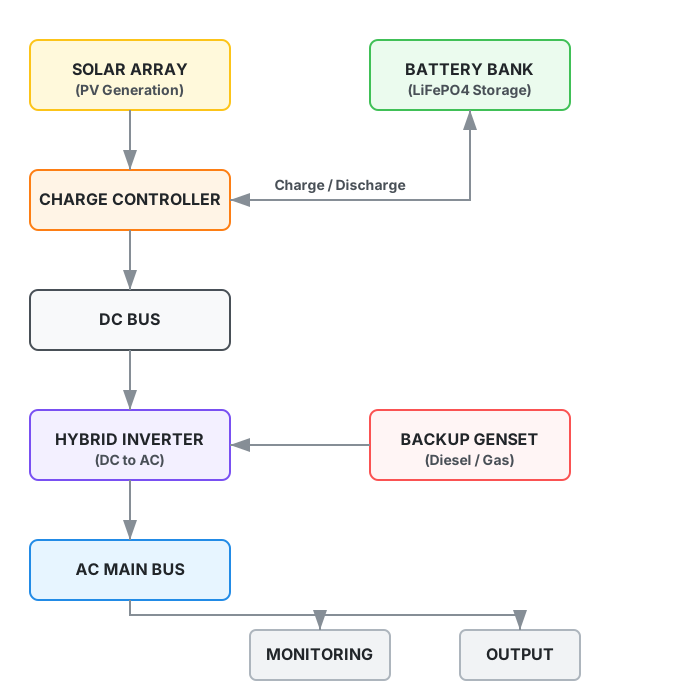
Flow Optimization
Solar Generation: Direct consumption during irradiance peaks to maximize PV yield.
Storage Management: Intelligent LiFePO4 discharge cycles covering critical night loads.
Hybrid Sync: Seamless integration with existing backup diesel/gas generation.
Technical Goal
"Engineered for 99.9% uptime using utility-grade Tier-1 components."
Network Layout
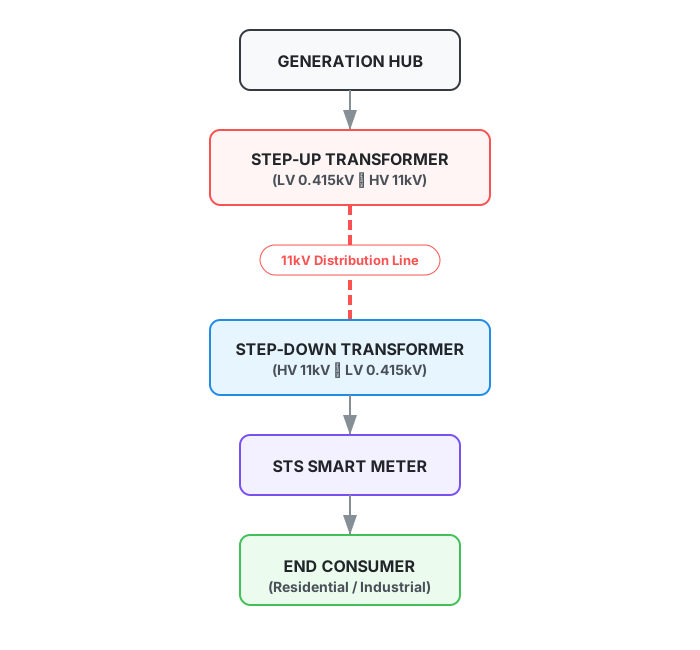
HV Distribution
- 01.
High-voltage transmission (11kV) for efficient long-distance energy transfer (>1km).
- 02.
Strategic transformer placement at consumer load clusters to reduce LV copper losses.
- 03.
STS Smart Metering ensuring >92% revenue collection efficiency.
Productive Use & Anchor Loads(high-consumption commercial users)
Load Curve Optimization
To maximize ROI, we prioritize Daytime Anchor Loads that match the PV generation curve. This strategy reduces battery depth-of-discharge (DoD) requirements and monetizes surplus energy that would otherwise be curtailed.
Telecom ESCO
Energy services supporting mission-critical telecom loads as stable revenue anchors.
Agro-Irrigation
Automated pumping synchronized with peak solar irradiance.
Cold Storage
Monetizing daytime surplus for industrial food preservation.
Ind. Milling
High-torque processing loads managed via smart sequencing.
Anchor Principle
"Commercial daytime consumers stabilize project debt-service coverage (DSCR), allowing for significantly lower cross-subsidized tariffs for residential households."
Infrastructure Development Group
Bankability Insight
Projects with >45% Productive Use contribution typically receive preferential debt-to-equity terms from DFI lenders due to predictable revenue.
Revenue Strategy
Diversified revenue streams ensuring predictable cash flow and bankability.
Anchor Loads
Telecom ESCO (Energy Service Company) & commercial users providing stable baseline revenue.
→ Improves cash flow predictability and strengthens DSCR performance
Community Demand
Aggregated residential & SME consumption with pre-paid metering.
Tiered Tariff Structure
Differentiated pricing by customer class and consumption tier.
Reduced Diesel Exposure
92%+ diesel displacement eliminating volatile fuel costs.
Optimized Fuel OPEX
Predictable operating costs enabling accurate financial planning.
Stable Long-Term Contracts
Multi-year energy purchase agreements with creditworthy off-takers.
Financial Indicators (Preliminary)
Key investment metrics and project economics.
CAPEX Estimate
₦ ___
Annual OPEX
₦ ___
Fuel OPEX Reduction
___%
Projected DSCR
___x
Target IRR
___%
Payback Period
___ Yrs
Note: Final metrics subject to completion of 48-72 hour load data validation.
Economic Case
Solar mini-grid eliminates high and volatile diesel fuel costs, improves system uptime vs. national grid, and delivers a predictable cost per kWh, enhancing investor returns.
Economic Advantage
Reduced Diesel Consumption
92%+ displacement of diesel generation
Lower Long-Term LCOE
Levelized Cost of Energy reduced by ~42%
Increased System Uptime
99.9% target vs. 30-60% grid average
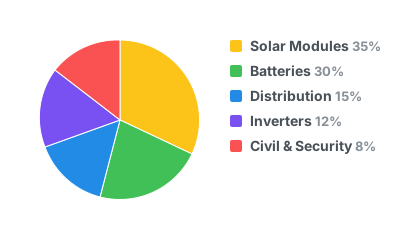
CAPEX Composition
Superiority Matrix
| Metric | Diesel Baseline | Solar Utility |
|---|---|---|
| Fuel Cost | ₦1,200+ / L | ₦0.00 |
| LCOE / kWh | ≈ ₦415.00 | ≈ ₦240.00 |
| Maint. Cycle | Monthly overhaul | 2% / Year |
Capital Structure
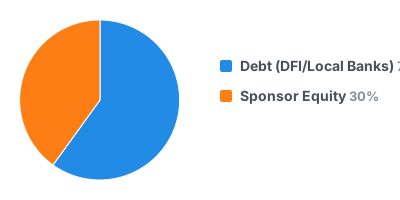
Revenue Waterfall
OPEX Displacement Calculator
Adjust operational variables to visualize the impact of transitioning from fossil fuels to solar infrastructure.
Monthly Spend
₦5,400,000
Monthly Strategic Savings
₦4,590,000
Annual Capital Recovery
₦55,080,000
Regulatory Framework
NERC Compliance
Isolated Permit
Adherence to the NERC Mini-Grid Regulation 2016 for standalone systems below 1MW capacity threshold.
Buy-out Protection
Pre-negotiated asset protection formulas ensuring full capital recovery in grid arrival scenarios.
Risk Mitigation
Harmattan Dust
30% PV Array Margin + Auto Cleaning
FX Volatility
USD-Indexed Equipment Contracts
Theft/Vandalism
Community Stakeholder Protocols
Stakeholder Engagement
Town Hall Models
Transparency protocols on tariffs and socio-economic local benefits.
Local Integration
Hiring local technical talent for day-to-day O&M and Security ops.
Social License
Engaging traditional leadership for long-term project protection.